Bertrand Russell once pointed out, "Be scrupulously truthful, even if the truth is inconvenient, for it is more inconvenient when you try to conceal it."
I've always had a hard time with Russell's work even though I was trained in the philosophy of language and his work was included in most of the syllabi and curricula I explored. It wasn't till after my title that I realized why Russell never rubbed off on me. I naturally and intellectually respond to aesthetics, philosophically and ontologically. Ergo, it stands to reason that I'd lack a measure of attraction to him. Of all the areas of knowledge, he was intent on leaving one particular pursuit out: aesthetics.
Russell had a knack for concise speech, however, and some of his observations on human nature are inspiring. I'll list a few below and you can judge for yourselves. They might even inspire you to read more of his work. Or not. Maybe they'll inspire you to self-examine with more gusto and bravery.
Truth. It's hard, this. It's hard because it rarely is purely quantifiable. Often it resides in the realm of circumstance, accidental caprice, and personal validation. Different people measure experience differently. Truth is inconvenient when it threatens to expose self-interest and damage/harm of the other. Truth, however, should not predicate itself on scruples for if it did, it becomes conditioned on them. I am certain Russell would object to this. I was attracted to his work enough to know this much about it. The more truth is concealed, the more diseased the discourse it gives birth to. Any philosopher would be repulsed by this outcome. Granted, the context Russell had in mind might have had more to do with the pernicious nature of certain religious rhetoric but be that as it may, truth, measurable truth, has to be free of personal gain. It should answer to nothing and no one.
In sum, here are a few of Russell's observations on an array of thing. Enjoy!
1) Do not feel absolutely certain of anything.
2) Do not think it worth while to proceed by concealing evidence, for the evidence is sure to come to light.
3) Never try to discourage thinking for you are sure to succeed.
4) Have no respect for the authority of others, for there are always contrary authorities to be found.
5) Do not use power to suppress opinions you think pernicious, for if you do the opinions will suppress you.
6) Do not fear to be eccentric in opinion, for every opinion now accepted was once eccentric.
7) Find more pleasure in intelligent dissent that in passive agreement, for, if you value intelligence as you should, the former implies a deeper agreement than the latter.
8) Do not feel envious of the happiness of those who live in a fool’s paradise, for only a fool will think that it is happiness.

Wednesday, May 9, 2012


Thursday, April 19, 2012
For Pete's Sake
I liked seeing Lane bruise Pete's ego a bit on the last episode of Mad Men. Other than that, the episode dragged. This season, as a matter of fact, is not to my liking but that's beside the immediate point at hand.
What I liked even more about this scene is Don and Sterling's desire to see them fight in the work place.
Pete is spiraling down this season. His spiraling, however, is covered by a cloud of success and his colleagues don't seem to see it as all they're observing at face level is the sweet smell of success that his work is providing. However, Beethoven's music in the background and his obsession with artillery and belligerence might just be a foreshadowing of things to come.
In the meantime, Lane: 1 - Pete: 0.
What I liked even more about this scene is Don and Sterling's desire to see them fight in the work place.
Pete is spiraling down this season. His spiraling, however, is covered by a cloud of success and his colleagues don't seem to see it as all they're observing at face level is the sweet smell of success that his work is providing. However, Beethoven's music in the background and his obsession with artillery and belligerence might just be a foreshadowing of things to come.
In the meantime, Lane: 1 - Pete: 0.
Assorted Links
1) I'm looking forward to Paul Seabright's new book The War of the Sexes: How Conflict and Cooperation Have Shaped Men and Women from Prehistory to the Present which is not coming out till April 29th. The title came to my attention recently and I'm looking forward to getting a non-lit theory perspective on a topic I have spent too much intellectual time on. A bit from the book description says:
"Men and women became experts at influencing one another to achieve their cooperative ends, but also became trapped in strategies of manipulation and deception in pursuit of sex and partnership. In early societies, economic conditions moved the balance of power in favor of men, as they cornered scarce resources for use in the sexual bargain. Today, conditions have changed beyond recognition, yet inequalities between men and women persist, as the brains, talents, and preferences we inherited from our ancestors struggle to deal with the unpredictable forces unleashed by the modern information economy. Men and women today have an unprecedented opportunity to achieve equal power and respect. But we need to understand the mixed inheritance of conflict and cooperation left to us by our primate ancestors if we are finally to escape their legacy."
 2)
2)
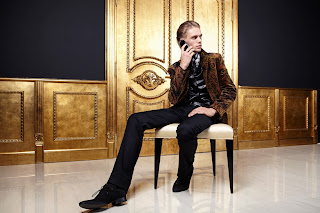
The urban datasexual? I suppose it's a term now. I never liked the term metrosexual when pop culturalists starting toying with the term on network TV till the rest of the channels picked it up. A bit from the article states, "The datasexual looks a lot like you and me, but what’s different is their preoccupation with personal data. They are relentlessly digital, they obsessively record everything about their personal lives, and they think that data is sexy. In fact, the bigger the data, the sexier it becomes. Their lives - from a data perspective, at least - are perfectly groomed."
I doubt I'll be heard using this term any time soon, however. The picture that accompanies the article, however, is mesmerizing. More here.
"Men and women became experts at influencing one another to achieve their cooperative ends, but also became trapped in strategies of manipulation and deception in pursuit of sex and partnership. In early societies, economic conditions moved the balance of power in favor of men, as they cornered scarce resources for use in the sexual bargain. Today, conditions have changed beyond recognition, yet inequalities between men and women persist, as the brains, talents, and preferences we inherited from our ancestors struggle to deal with the unpredictable forces unleashed by the modern information economy. Men and women today have an unprecedented opportunity to achieve equal power and respect. But we need to understand the mixed inheritance of conflict and cooperation left to us by our primate ancestors if we are finally to escape their legacy."

The urban datasexual? I suppose it's a term now. I never liked the term metrosexual when pop culturalists starting toying with the term on network TV till the rest of the channels picked it up. A bit from the article states, "The datasexual looks a lot like you and me, but what’s different is their preoccupation with personal data. They are relentlessly digital, they obsessively record everything about their personal lives, and they think that data is sexy. In fact, the bigger the data, the sexier it becomes. Their lives - from a data perspective, at least - are perfectly groomed."
I doubt I'll be heard using this term any time soon, however. The picture that accompanies the article, however, is mesmerizing. More here.
Monday, April 16, 2012
HBO's Girls: A Review
Lena Dunham's new comedy on HBO, Girls, is a show anyone who's interested in good story-telling, intelligent and honest discussion of gender and sociality, and brilliant humor should see. If shows like New Girl, Whitney or whatever other excuse for entertainment is out there claiming to tackle woman- and girl-hood have been in your radar due to incessant marketing by mainstream networks, you will - thankfully - forget all about them after seeing this show.
The pilot was awkwardly and honestly funny. And awkward and honest is rarely a bad combo when it comes to comedy. Anyone who has the bug of creativity will be bound to relate to Hannah, the main character. Hannah's an only child. She's 24, has graduated with a major in English, and is working, well, interning, in the mecca of the publishing world: New York City. The daughter of two professors, Hannah thinks that she can rely on her parents supporting her till her internship gets converted into a job.
Alas, over a dinner of pasta and chardonnay, her parents inform her that after two years of supporting her post-college, they have decided to let her fly solo. And this is when the story gets awkward, hence promisingly good.
Hannah's a hub of insecurities which she seems to be able to turn into a strangely bearable self-mythologizing parody are what make the show. And, boy, there are plenty of great ones.
I like this. I like it because it's closer to anything real that girls, women, and the creatives encounter when trying to do real life. Thankfully, voices like Lena Dunham are bright, loud, and funny enough to drown out all the other nonsense that network TV tries to push people into liking. A narrative is only good when it is relatable. That, this show is.
Saturday, April 14, 2012
"What is Philosophy" in a Card
I just read a review over in Brain Pickings about the question of what philosophy is and I got a kick out of one of the quotes therein as it happens to be the very same my folks had put in a card they gave me after the ceremony.
So, I did some digging, found the picture with the card, and voila.
The quote read: “Philosophy is an unusual subject in that its practitioners don’t agree what it’s about. - Nigel Warburton”

So, I did some digging, found the picture with the card, and voila.
The quote read: “Philosophy is an unusual subject in that its practitioners don’t agree what it’s about. - Nigel Warburton”

Things to Read I Recommend

1) I'm currently reading Going Solo - The Extraordinary Rise and Surprising Appeal of Living Alone by NYU professor of sociology, Eric Klinenberg. I've known about the research for about 5 years but had no idea that the book had just come out. Klinenberg suggests that living alone provides “restorative solitude” and that it may be “exactly what we need to reconnect.”
His data suggests that single living is an inevitable outgrowth of mainstream liberal values. Women’s liberation, widespread urbanization, communications technology, and increased longevity—these four trends lend our era its cultural contours, and each gives rise to solo living. The “communications revolution” that began with the telephone and continues with Facebook helps dissolve the boundary between social life and isolation. Urban culture caters heavily to autonomous singles, both in its social diversity and in its amenities: gyms, coffee shops, food deliveries, laundromats, and the like ease solo subsistence. Kleinenberg points out that almost unequivocally all of his many subjects said that being lonely meant choosing to be with the wrong person.
I will review the book once I am done reading it.

2) This is a truly fascinating essay. I'm currently using it on my own research. It comes from the 18th century and the very homophobic England. Jeremy Bentham had the courage to pen this at a time when paederasty was punished by hanging.
"Bentham advocates the decriminalization of sodomy, which in his day was punished by hanging. He argues that homosexual acts do not "weaken" men, or threaten population or marriage, and documents their prevalence in ancient Greece and Rome. Bentham opposes punishment on utilitarian grounds and attacks ascetic sexual morality."
Bentham contextualizes the discussion of homosexuality by first highlighting its mainstream-ness in Ancient Greece and Rome. He says, "In Athens and in ancient Rome in the most flourishing periods of the history of those capitals, regular intercourse between the sexes was scarcely much more common. It was upon the same footing throughout Greece: everybody practised it; nobody was ashamed of it."
3) This is pretty, pretty good. As a long-time fan of Tyler Cowen, I'm so pre-ordering this. The six rules for dining out:
"When you enter a restaurant, you don’t want to see expressions of disgust on the diners’ faces, but you do want to see a certain seriousness of purpose. Pull out a mirror and try eating some really good food. How much are you smiling? Not as much as you might think. A small aside: in many restaurants, it is a propitious omen when the diners are screaming at each other. It’s a sign they are regular customers and feel at home."
More here.
Wednesday, March 21, 2012
Politics of Friendship
I've long maintained that the philosophy-inclined person is naturally likely to feel an affinity with the Greeks and Romans. After all, they gave us the blueprint for closeness and intimacy, things on which our enculturation rests.
The first time I heard of Derrida's work on friendship and politics was over a quick, friendly chat with one of my dissertation committee members. He said, jokingly, that one could expect anything from Literary Theory these days. Derrida, the pater of deconstruction, was working on friendship in the twilight of his years. I said that I wasn't all that surprised that he would choose to dedicate the last years of his research life to such a pursuit.
What else do we preoccupy ourselves with, anyway? Even the least attached of people, is consumed with thoughts of attachment. The latter looks different in different people. Whether we attach to people or the results of associations with people and/or sources of interest, human beings are burdened with the concern of attachment as we simply cannot survive on our own. Plato, by way of Aristophanes, tells us of the cravings we have to feel more empowered and less choppy and how they're rooted in our choppy natures. Our inadequacy, which often feels to be emotional and mental, is very much physical, according to him. Zeus and the gods chopped us up, says Aristophanes, and, as a result, we're perpetually looking for the missing parts so that we can fit again. Metaphorically, the more valid point that the Greeks were making is that association, or sociality at large, is not a matter of choice for most who choose to live, and live well, in society. Sociality is a matter of necessity.
True simbiosis is rarely present. Faux simbiosis, however, is the very cradle of sociality. Fake things are not always problematic, however. Nietzsche talks of collective lying and the decisions we've made to believe it as truth for the sake of living. The pretense of the real thing seems to become in time the thing itself. And therein lies the importance of such notions as friendship, attachment, loyalty of sociality, et al. Such tenets are important to civilized society as they are the unspoken agreement on which various channels support themselves.
In my own 398-page musings on literature and philosophy in the Middle Ages, I explored the concept of medieval friendship at length. Granted, I mostly wrote about its function and utility but, as much of the Western canon shows, we cannot comment on our culture and civilization without tipping the hat to the work of Plato and co., on the matter.
Many view Derrida's work in the twilight of his life as less substantial than his monumental contribution to Literary Theory i.e. Deconstruction I mean, the number of faculty hired as practitioners of his theory alone is enough to worship at his altar. At least, till tenure.
Derrida's musings on friendship are not novel, however. They're very much imitative of the Greeks. Plato's Symposium after all is nothing if not a collection of chats with friends over wine. In vino vertias as later on, their friends to the North would say.
You can read the rest of Derrida's comments on politics and friendship here. Below is a snippet from it:
"... the friendship grounded on utility and usefulness, and this is political friendship ... and on the lower level, friendship grounded on pleasure - looking for pleasure among young people, Aristotle says. So you see that we have a concept of friendship which is and is not political. The political friendship is one kind of friendship ... So, there are a number of problems in which you see love - not love, but philia or friendship playing an organising role in the definition of the political experience."
The first time I heard of Derrida's work on friendship and politics was over a quick, friendly chat with one of my dissertation committee members. He said, jokingly, that one could expect anything from Literary Theory these days. Derrida, the pater of deconstruction, was working on friendship in the twilight of his years. I said that I wasn't all that surprised that he would choose to dedicate the last years of his research life to such a pursuit.
What else do we preoccupy ourselves with, anyway? Even the least attached of people, is consumed with thoughts of attachment. The latter looks different in different people. Whether we attach to people or the results of associations with people and/or sources of interest, human beings are burdened with the concern of attachment as we simply cannot survive on our own. Plato, by way of Aristophanes, tells us of the cravings we have to feel more empowered and less choppy and how they're rooted in our choppy natures. Our inadequacy, which often feels to be emotional and mental, is very much physical, according to him. Zeus and the gods chopped us up, says Aristophanes, and, as a result, we're perpetually looking for the missing parts so that we can fit again. Metaphorically, the more valid point that the Greeks were making is that association, or sociality at large, is not a matter of choice for most who choose to live, and live well, in society. Sociality is a matter of necessity.
True simbiosis is rarely present. Faux simbiosis, however, is the very cradle of sociality. Fake things are not always problematic, however. Nietzsche talks of collective lying and the decisions we've made to believe it as truth for the sake of living. The pretense of the real thing seems to become in time the thing itself. And therein lies the importance of such notions as friendship, attachment, loyalty of sociality, et al. Such tenets are important to civilized society as they are the unspoken agreement on which various channels support themselves.
In my own 398-page musings on literature and philosophy in the Middle Ages, I explored the concept of medieval friendship at length. Granted, I mostly wrote about its function and utility but, as much of the Western canon shows, we cannot comment on our culture and civilization without tipping the hat to the work of Plato and co., on the matter.
Many view Derrida's work in the twilight of his life as less substantial than his monumental contribution to Literary Theory i.e. Deconstruction I mean, the number of faculty hired as practitioners of his theory alone is enough to worship at his altar. At least, till tenure.
Derrida's musings on friendship are not novel, however. They're very much imitative of the Greeks. Plato's Symposium after all is nothing if not a collection of chats with friends over wine. In vino vertias as later on, their friends to the North would say.
You can read the rest of Derrida's comments on politics and friendship here. Below is a snippet from it:
"... the friendship grounded on utility and usefulness, and this is political friendship ... and on the lower level, friendship grounded on pleasure - looking for pleasure among young people, Aristotle says. So you see that we have a concept of friendship which is and is not political. The political friendship is one kind of friendship ... So, there are a number of problems in which you see love - not love, but philia or friendship playing an organising role in the definition of the political experience."
Sunday, March 18, 2012
Innate Intelligence and the Workplace
My best friend sent me a link to a New York Times article that I found particularly good. In the subject heading my friend writes, "interesting interview I thought might be relevant to you." And he was right. The subject of the piece is Pamela Fields of Stetson. Fields is not only impressively successful and full of business acumen, she's a perfect example of what the very educated can contribute to the business field. She, like very few I have read about and know in real life, has the ability to capture the essence of success and what it entails.
The opening of the article contains the following:
"I majored in nuclear engineering and nuclear arms control through the Woodrow Wilson School at Princeton. But when I went to work for an engineering firm, it was the wrong fit. It was terrible, and I had no business to be there. So I decided I wanted to go into cosmetics, and I went to the phone book, opened it up to the cosmetics and beauty section, and I started with A. The first company I saw that I had heard of was Avon. So I called them up — this goes under chutzpah — and I said: “I’m Pam Fields, I can speak Portuguese, French and Italian fluently. I know you’re a global company. Surely you need me.” As it turns out, they did. They had an opening on the Brazil desk, which is to this day one of their biggest markets. I learned to choose which of their thousand products should go into their little biweekly brochure."
"Ha," I thought to myself. My friend knows I'd react to the piece the way I did. When reading the article I was reminded of the many times I felt oddly placed in the most unique of places. What gave me comfort every single time, however, was knowledge and the information I had to offer. I was in those places for a reason. I was there to contribute what I knew. First, there's the medieval conference in the Pacific Northwest to which I arrived late as a result of a connecting flight being delayed. As a result, I got to the University of Washington's campus in the nick of time for my own presentation. I had no time to change. And I remember vividly what I was wearing. I had a vintage green tanktop on, brown corduroy pants I used to call my 'flight pants,' and brown and beige Puma shoes. Ah, and a leather bracelet my friend Nat had made for me which I used to wear to all the rock shows we'd go to. I looked like the opposite of a university professor. Deep down I got a kick out of it, actually. So what, profs can't rock corduroy?!
I clashed in a sea of suits, grey hair, well-trimmed beards, tweet jackets, yes, and old but respectable-looking leather bound notebooks. In typical fashion, I did not have a hard copy of my presentation as I had made last-minute edits on the flight to Oregon. Instead, I took out my iPhone, opened the attachment from my email and started my presentation by saying, "I apologize for my unorthodox sartorial decisions. I had no time to change. My suit, freshly pressed, is in the rental car I picked up at the airport and parked in the loading zone five minutes ago. My presentation is on perversions of courtly love not Courtney Love even though considering we're in Seattle and I'm looking how I'm looking... " At this point, a few of them started to crack something resembling a smile. I knew I was ok. I had said and looked the opposite of what was expected. But I had made the effort to there in time. I spoke about my work. I knew my stuff. I got it done. Often, we get bogged down by presentation and form and forget that it is actually the content that trumps all.
The day of my PhD defense my parents got me a tweed suit. I am not joking. It was a form fitting skirt and jacket combo. Instead of wearing it how it was 'meant' to be worn, I paired the jacket with a shirt that said 'Kick Like a Girl' on it. Oh, and I had my hair in two pigtails. "You realize you're going in pigtails to talk about Plato for the next 8 hours, right? It's your PhD defense... Alright, well, let's roll then." I said nothing on the drive to campus. We stopped at Starbucks. I got my venti macchiato and the rest is history.
The second example comes from a recent interview I had for a promotion. After the 2-hour interview I was asked what I thought of it. In my answer I said that if I could have employed less economy of speech when explaining my work and experience during the past decade I wouldn't necessarily do it. Then I said, "I know lots of big words. And lots of small words. I also know there's many more I need to add to my inventory. Of words." We do not need to recite our achievements to the world. That's what a resume is for. Abilities are showcased by a composite of performance, experience, and behavior that can't be captured by static words on a piece of paper. Ah, and humor matters. If your work on courtly love won't be paid attention to because you're in corduroys as opposed to tweed or your business abilities won't be appreciated because you just know too many big words, then it's best for all involved to break up. There's a lid for every pot, after all. If not, those who adapt with more ease than others, will fit into some pot that's closest to their lid.
I've always had a hard time with the ownership part of knowledge and achievement. I don't know why. I'm constantly having to deal with it and I don't like it that I do. There must be others out there who feel like they're reading about someone else when they read their own work or their own list of achievements.
When I got my PhD, my person started cracking jokes around the house calling me "Dr. Bri." When in academia, students, often twice my age, would come to my office and say, "Dr. Ribaj, do you have a minute?" Or write emails saying, "Dr. Ribaj, would you grant me an audience during your office hours?" Often, I'd find it too hard to resist smirking. I guess they're talking to me. And then we'd talk about the stylistic nuances of Thomas Aquinas and Augustine. You know, things one discusses generally and on any given Monday. I never internalized that part of life. I had things compartmentalized beautifully. But that informs the other compartments as well. Living is not something that's done in isolation. It leaks. It gets messy and compartments collide and spill over. They cannot help but inform one another.
In sum, I'd like to 'circle back' as I just learned middle management loves to say, to the article on Fields. When asked about what she looked for when looking to hire, she said:
"I look for innate intelligence. You hear that by the way people talk, by the way they express themselves, by the level of sophistication of their answers. I ask them to send me a letter after the interview about what they thought about our conversation and what they thought was good, what left them uncomfortable, were there any areas that we didn’t discuss, is there something that they forgot to brag about? A lot of people can’t write anymore. I mean, they would be thrown out of eighth-grade class. In my house, my father learned English as a second language, and if I got an A on a paper and I spelled a word wrong, that’s what I heard about.
....The other thing I look for is people who have varied experience. I will always give the nod to people who have done different things over people who have grown up linearly within an organization. It’s my own bias, because I think that by working at Company A and Company B and Company C and Company D they can bring tremendous perspective to the discussion that they wouldn’t have if they only knew one."
I get her. And she's yet another good example of someone who proves that higher academia and business are not territories that preclude one another.
The opening of the article contains the following:
"I majored in nuclear engineering and nuclear arms control through the Woodrow Wilson School at Princeton. But when I went to work for an engineering firm, it was the wrong fit. It was terrible, and I had no business to be there. So I decided I wanted to go into cosmetics, and I went to the phone book, opened it up to the cosmetics and beauty section, and I started with A. The first company I saw that I had heard of was Avon. So I called them up — this goes under chutzpah — and I said: “I’m Pam Fields, I can speak Portuguese, French and Italian fluently. I know you’re a global company. Surely you need me.” As it turns out, they did. They had an opening on the Brazil desk, which is to this day one of their biggest markets. I learned to choose which of their thousand products should go into their little biweekly brochure."
"Ha," I thought to myself. My friend knows I'd react to the piece the way I did. When reading the article I was reminded of the many times I felt oddly placed in the most unique of places. What gave me comfort every single time, however, was knowledge and the information I had to offer. I was in those places for a reason. I was there to contribute what I knew. First, there's the medieval conference in the Pacific Northwest to which I arrived late as a result of a connecting flight being delayed. As a result, I got to the University of Washington's campus in the nick of time for my own presentation. I had no time to change. And I remember vividly what I was wearing. I had a vintage green tanktop on, brown corduroy pants I used to call my 'flight pants,' and brown and beige Puma shoes. Ah, and a leather bracelet my friend Nat had made for me which I used to wear to all the rock shows we'd go to. I looked like the opposite of a university professor. Deep down I got a kick out of it, actually. So what, profs can't rock corduroy?!
I clashed in a sea of suits, grey hair, well-trimmed beards, tweet jackets, yes, and old but respectable-looking leather bound notebooks. In typical fashion, I did not have a hard copy of my presentation as I had made last-minute edits on the flight to Oregon. Instead, I took out my iPhone, opened the attachment from my email and started my presentation by saying, "I apologize for my unorthodox sartorial decisions. I had no time to change. My suit, freshly pressed, is in the rental car I picked up at the airport and parked in the loading zone five minutes ago. My presentation is on perversions of courtly love not Courtney Love even though considering we're in Seattle and I'm looking how I'm looking... " At this point, a few of them started to crack something resembling a smile. I knew I was ok. I had said and looked the opposite of what was expected. But I had made the effort to there in time. I spoke about my work. I knew my stuff. I got it done. Often, we get bogged down by presentation and form and forget that it is actually the content that trumps all.
The day of my PhD defense my parents got me a tweed suit. I am not joking. It was a form fitting skirt and jacket combo. Instead of wearing it how it was 'meant' to be worn, I paired the jacket with a shirt that said 'Kick Like a Girl' on it. Oh, and I had my hair in two pigtails. "You realize you're going in pigtails to talk about Plato for the next 8 hours, right? It's your PhD defense... Alright, well, let's roll then." I said nothing on the drive to campus. We stopped at Starbucks. I got my venti macchiato and the rest is history.
The second example comes from a recent interview I had for a promotion. After the 2-hour interview I was asked what I thought of it. In my answer I said that if I could have employed less economy of speech when explaining my work and experience during the past decade I wouldn't necessarily do it. Then I said, "I know lots of big words. And lots of small words. I also know there's many more I need to add to my inventory. Of words." We do not need to recite our achievements to the world. That's what a resume is for. Abilities are showcased by a composite of performance, experience, and behavior that can't be captured by static words on a piece of paper. Ah, and humor matters. If your work on courtly love won't be paid attention to because you're in corduroys as opposed to tweed or your business abilities won't be appreciated because you just know too many big words, then it's best for all involved to break up. There's a lid for every pot, after all. If not, those who adapt with more ease than others, will fit into some pot that's closest to their lid.
I've always had a hard time with the ownership part of knowledge and achievement. I don't know why. I'm constantly having to deal with it and I don't like it that I do. There must be others out there who feel like they're reading about someone else when they read their own work or their own list of achievements.
When I got my PhD, my person started cracking jokes around the house calling me "Dr. Bri." When in academia, students, often twice my age, would come to my office and say, "Dr. Ribaj, do you have a minute?" Or write emails saying, "Dr. Ribaj, would you grant me an audience during your office hours?" Often, I'd find it too hard to resist smirking. I guess they're talking to me. And then we'd talk about the stylistic nuances of Thomas Aquinas and Augustine. You know, things one discusses generally and on any given Monday. I never internalized that part of life. I had things compartmentalized beautifully. But that informs the other compartments as well. Living is not something that's done in isolation. It leaks. It gets messy and compartments collide and spill over. They cannot help but inform one another.
In sum, I'd like to 'circle back' as I just learned middle management loves to say, to the article on Fields. When asked about what she looked for when looking to hire, she said:
"I look for innate intelligence. You hear that by the way people talk, by the way they express themselves, by the level of sophistication of their answers. I ask them to send me a letter after the interview about what they thought about our conversation and what they thought was good, what left them uncomfortable, were there any areas that we didn’t discuss, is there something that they forgot to brag about? A lot of people can’t write anymore. I mean, they would be thrown out of eighth-grade class. In my house, my father learned English as a second language, and if I got an A on a paper and I spelled a word wrong, that’s what I heard about.
....The other thing I look for is people who have varied experience. I will always give the nod to people who have done different things over people who have grown up linearly within an organization. It’s my own bias, because I think that by working at Company A and Company B and Company C and Company D they can bring tremendous perspective to the discussion that they wouldn’t have if they only knew one."
I get her. And she's yet another good example of someone who proves that higher academia and business are not territories that preclude one another.
Wednesday, March 14, 2012
The Ballad of Genesis and Lady Jaye: A Story of the Pandrogyne

I plan to see this. While checking out the previews I got to thinking of Hedwig and the Angry Inch. I also thought of the theory-laden film High Art, a favorite when it came out and one that I have been feeling like revisiting lately.
Lovers of industrial music will undoubtedly find this documentary especially intriguing as it features Genesis Breyer P-Orridge, the founding member of Throbbing Gristle. The life story of P-Orridge is one of unique pursuits and brave edification. The one term that will stand out to most will be the term pandrogyne and how it gets contextualized in the actual lives and love story of two individuals.
You can learn more about the film here.
Wednesday, February 22, 2012
Couples Wearing Each Other's Clothes

My best friend just made me aware of the following photographs by sincerelyhana.com showcasing gender performance in the sartorial confines of quotidianity. The photographs proved distracting as I navigate fatigue. As I was perusing the site, I got to thinking of a sort-of-similar exercise in my own life.
The exercise was most curious as it went beyond fabric choice, situational layering, and gender performance. The semiotics of fashion is something I've long concerned myself with as I've always deemed presentation to be much more than just unsubstantiated form. The first time I was asked to give up an item of clothing for the purpose of swapping was in my first long-term relationship. Apparently, it was some sort of a rite of passage. I was asked for a t-shirt so that the other party could wear it when being away for a week.
I found the request strange.
As much as I'm keen on tropes, my brain is a tad too enamored with literalness. I'm attached to the words' literal meaning. This propensity is what made me excel in academic pursuits. It's mostly a challenge when dealing with people who don't view words as a melange of primary, secondary, and tertiary meanings, but I'm getting off topic.
I suppose, it's hard to shake linguistic conditioning and having grown up with lexical diversity, getting attached to primary meanings meant clearer communication and easier living.
The question was: "Can I take one of your shirts with me?"
My answer was something akin to, "Oh, do you need to get a new one for the trip? We can go and buy you one." Instantaneously, I went through my inventory of shirts and I started thinking which shirt the other party had in mind. "Which one was goes went well with your travel pants and shoes?"
"What do you mean?"
"I mean, which color?"
"Why does that matter?"
"Well, you want it to go with your other stuff, ja?"
"The color doesn't matter. Just any shirt will do."
I remember finding the request most bizarre at that point. And, just like I tend to do with topics I'm not fully satisfied with and/or finished with, I got to work.
I missed the point of the request. The request came from a place of intimacy and olfactory closeness. I saw it as one of travelling need. I was fretting about it. "Well, I can give you this, or that, or the other one. I mean, I like green. You don't care for green. I like form-fitting, you'll have a hard time with that. Unless you wear it as an undergarment type thing and then you wear a shirt of your own that fits on top of it. Should we go shopping? Let's go shopping and we'll find something like the one I have but in your size. Then we can be twins."
"Just pick one, really. The one you have on will do, actually."
At that point I distinctly remember thinking, "but I wear this Tuesdays. It's my comfort Tuesday shirt. I write in this. Why would you want this one?! What would I be wearing on Tuesday then?"
I actually, left my office in the middle of the day, went to a department store, and actually bought the exact same favorite shirt of mine but in another size. I was proud of myself for having found it. Eureka! But then when I got home, my beaming vanished when my shirt was met with: "you got me a new one?! [Grunt] It's fine really. I meant one of your own. You know, a used one."
I was still dense.
I still didn't get it. "Should I have gone to a vintage store, you know, I don't like the smell in places like that but we can go and see if we can find a second-hand shirt that looks like mine." As soon as I said it, we both started laughing as I became aware of my having completely missed the point of the exercise. In an effort to appear more of a caring person, I said, "how about this? How about you pick one of mine and I'll pick one of yours. You don't have anything green, do you?"
My literal self still found it bizarre that we had to swap shirts. My figurative self found the exercise interesting, however. And there we went. We swapped shirts and lied to each other. We did what was expected of a shirt-swapping couple. We lied about what a good fit the other's shirt was and how it went well with our respective complexions. And yada, yada, yada.
You can see the rest of the couples' switcheroo project here.
Subscribe to:
Posts (Atom)
www.brikenaribaj.com


 Posts
All Comments
Posts
All Comments